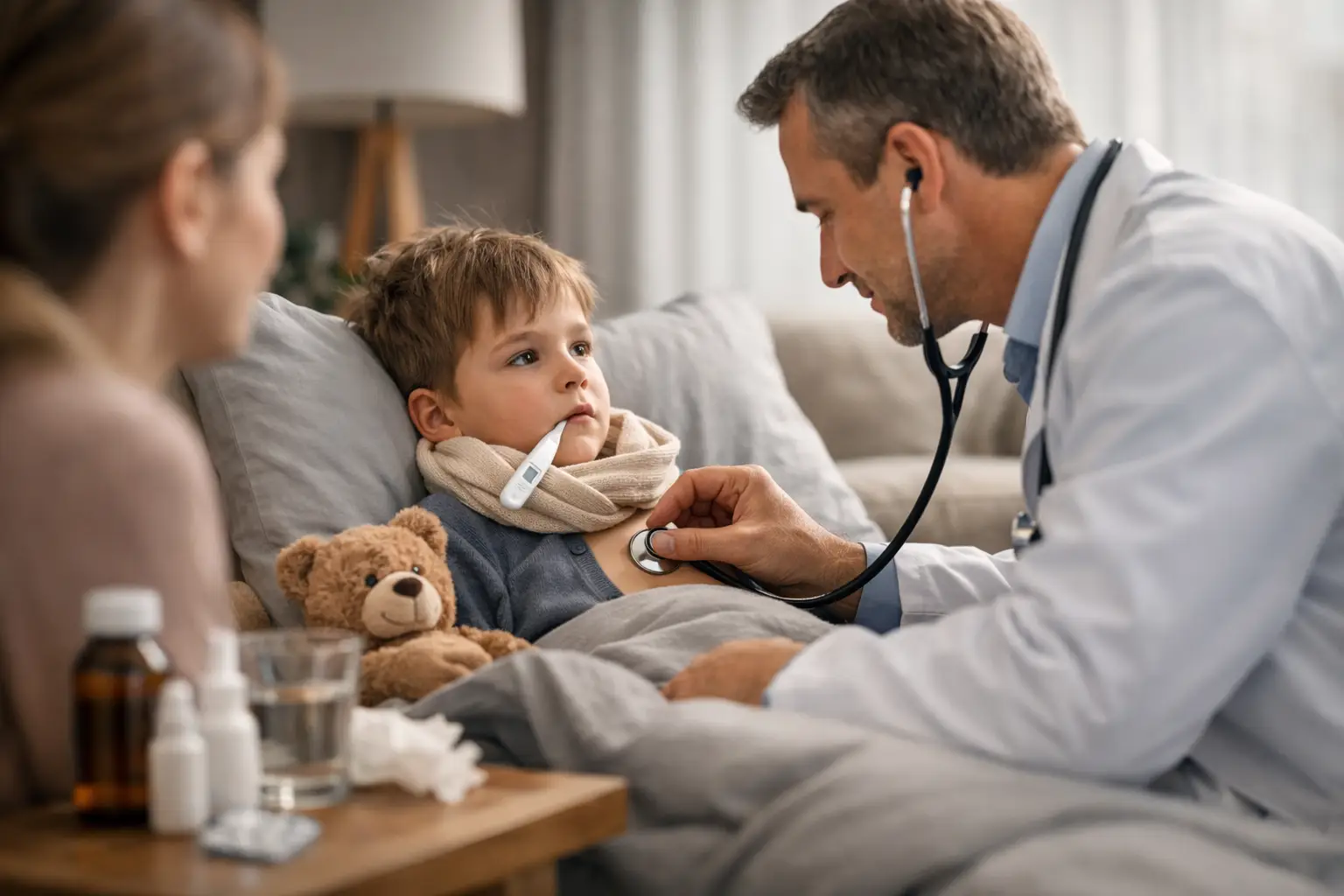
A fever in the evening, a cough at night, a listless child on the sofa—this is exactly when many parents ask the same question: child ill, doctor at home—can you do that, and when is a home visit really worthwhile? If your child is acutely unwell but there’s no obvious emergency, an examination in familiar surroundings can be a real relief—for your child and for the whole family.
Child ill, doctor at home – what are the benefits?
Getting a sick child out of bed, dressed, into the car, and into a crowded waiting room is often more of a strain than a help. Especially with fever, severe fatigue, vomiting, or pain, getting to a practice is physically and logistically exhausting. At home, the situation can often be assessed more calmly.
For children, familiar surroundings are not only more comfortable medically, but often more informative too. At home, they often show more naturally how they really feel. Parents can describe symptoms, progression, and any specifics directly—without rush or time pressure. That often makes the assessment more accurate.
There’s also a factor that’s easily underestimated in everyday life: time. If you need to organize childcare with a sick child, look after siblings, or even be mobile at night, you need a solution that’s medically reliable and practical. A doctor’s home visit can be exactly the right answer.
Which symptoms a home visit for children can be useful for
Not every cold requires immediate medical attention. But there are many situations where an examination at home makes sense even though an ambulance isn’t needed. These include, for example, high or persistent fever, severe sore throat, earache, a noticeable cough, gastrointestinal symptoms with weakness, rashes, or pain of unclear cause.
Even if a child seems unusually lethargic, hardly wants to drink, or symptoms worsen in the evening or at the weekend, parents often want a quick, clear assessment. This is where a home visit helps: it’s not just about treatment, but also reassurance. Is it something you can continue to monitor at home? Are medications needed, closer follow-up, or referral to a hospital after all?
With younger children, uncertainty is often greater because symptoms are harder to interpret. A two-year-old can’t explain well where it hurts. An infant may just seem different than usual. In such cases, a doctor’s on-site assessment is especially important.
What doctors can do at home for a sick child
A home visit is more than a quick visual check. Depending on the symptoms, a thorough examination can be carried out on site—looking at general condition, breathing, circulation, temperature, throat, ears, lungs, abdomen, or skin. Assessing how urgent the situation really is is also part of it.
Often, treatment can be started right away. This includes, for example, prescribing suitable medication, advice on reducing fever, treating minor wounds, or clear guidance on what parents should watch for over the next few hours. If needed, prescriptions or medical certificates can also be issued.
The biggest advantage is not only the examination itself, but the calm, unhurried conversation. Parents can ask questions that often get short shrift in a busy practice: When does a fever become critical? How much should the child drink? When do we need to act again? In acute family situations, this guidance is often just as valuable as the treatment itself.
When a sick child and a doctor at home isn’t enough
As comfortable and relieving as a home visit is, it does not replace emergency care. There are warning signs where you should not wait for a home visit, but call emergency services immediately via 112. These include severe shortness of breath, seizures, impaired consciousness, bluish lips, severe allergic reactions, serious injuries, or the impression that the child is acutely life-threateningly ill.
Extra caution also applies to very young infants. Even a fever can quickly require urgent assessment. Whether a home visit, out-of-hours service, or hospital is the right route then depends heavily on age and overall condition.
There are also cases where an initial medical assessment at home makes sense, but a referral to a children’s hospital or a suitable facility should follow. That’s not a drawback of a home visit—it’s part of responsible care. Good medicine doesn’t mean trying to solve everything on site, but arranging the right care for the specific situation.
Home visit, 116117 or 112 – what’s the difference?
Many parents hesitate between several options. That’s understandable, especially in the evening or at the weekend. 112 is for acute emergencies where no time can be lost. 116117 is the right point of contact for the statutory out-of-hours medical service for urgent but not life-threatening complaints.
A private doctor home visit is for families who want fast medical help without a waiting room and without travel—more personal time, direct availability, and treatment in their own environment. This can be especially appealing when the child is exhausted, logistics are difficult, or discretion matters.
So the difference isn’t the seriousness of the medicine, but the care model. A home visit offers comfort, timely help, and personal care. Billing is transparent according to the German medical fee schedule (GOÄ) and is aimed at privately insured patients or self-payers. If that’s exactly what you’re looking for, you’re choosing this form of care deliberately.
How parents can prepare for a home visit
If a doctor comes to your home, a little preparation helps. Have the key information ready: How long have the symptoms been present, how high was the fever, was there vomiting, were any medications given, is the child drinking, are there any pre-existing conditions or allergies? The child health booklet (U-Heft), any existing medications, and—if available—measured values are also helpful.
It’s also important not to stress the child unnecessarily. They don’t need to be sitting neatly in the living room. Often it’s best if they stay where they feel most comfortable. The examination usually works just as well in your arms, in bed, or on the sofa.
If parents are unsure whether they should call at all, a simple rule applies: it’s better to describe the situation and have it assessed professionally than to wait too long out of uncertainty. Especially with children, things can sometimes deteriorate faster than you initially expect.
What parents often want to know when a child is treated at home
A common concern is whether an examination at home can be as thorough as in a practice. In many acute, non-life-threatening cases, the answer is clearly: yes. What matters isn’t the location, but the doctor’s experience, the examination, and whether the symptoms can be assessed well on site.
Equally important is what to expect from the process. Not every illness needs antibiotics right away, and not every high fever is automatically dangerous. Sometimes the best medical care is ruling out a serious cause, treating symptoms appropriately, and giving parents clear criteria for what to monitor.
That’s exactly where personal care shows its strength. If you’re not rushed through, you understand better what’s going on and which next steps are truly necessary.
When you need fast help and calm at the same time
For families in Nuremberg, Fürth, Erlangen, and the surrounding area, a mobile private doctor home visit can be an excellent solution when a child is acutely unwell and a prompt examination at home is the least stressful option. nightdoc.de is designed for exactly these situations: personal medical help on site, outside regular practice hours, clearly communicated, and focused on what families really need in a tense moment.
When a child is ill, it’s not only the right diagnosis that matters, but also how the help arrives. Sometimes the best option isn’t the trip to the waiting room, but the doctor who comes to where your child feels safest.


Leave a Reply