

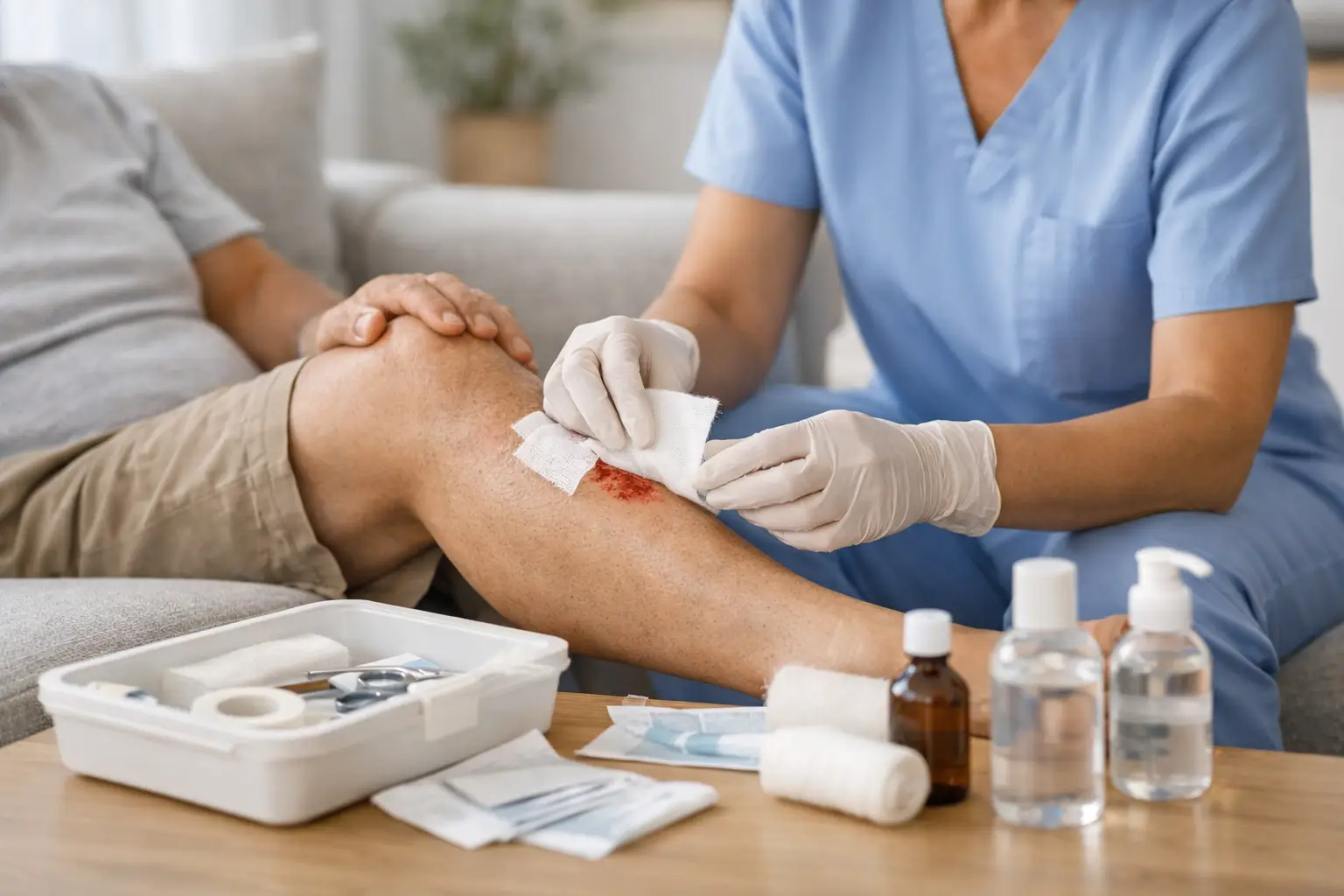
A cut while cooking, a burst abrasion after a fall, or a heavily weeping wound after a minor procedure—when it comes to wound care at home, it’s not just speed that matters, but above all the right assessment. Many wounds can be treated well at first. Others look harmless but still need medical care to prevent infection, poor healing, or unsightly scarring.
Wound care at home: What to do right away
The first step is always to stay calm. If you react in a rush, it’s easy to miss how deep a wound really is or whether there’s still dirt, splinters, or foreign material inside. Clean hands are essential. If possible, wash or disinfect your hands before touching the wound.
If the injury is bleeding, start with direct pressure using a clean sterile pad or, if necessary, a fresh cloth. Minor bleeding often stops after a few minutes. The key is not to keep checking. Lifting the dressing again and again disrupts the body’s natural clotting.
Once the bleeding is under control, the wound should be cleaned carefully. For superficial injuries, clean water or sterile saline is usually enough. Harsh agents such as high-proof alcohol or other strongly irritating substances are not a good idea. They don’t just sting—they can also damage healthy tissue.
Next comes an appropriate covering. A sterile dressing protects against dirt and friction. Whether a plaster, pad, or bandage makes sense depends on the wound’s size, location, and how much it’s weeping. A small cut on a finger needs something different than an abrasion on the knee or a laceration on the lower leg.
What you can treat yourself—and what you shouldn’t
Not every injury needs a doctor right away. Small, superficial cuts or abrasions without heavy bleeding can often be managed well at home—especially if the wound edges are smooth, the area is clean, and the skin isn’t pulling far apart.
It gets more complicated with deep wounds, gaping cuts, bite injuries, heavily contaminated wounds, or injuries to the face, joints, or hands. This isn’t just about healing, but also function and cosmetic outcome. A hand wound that looks small at first glance can involve tendons, nerves, or deeper structures.
For people with diabetes, circulatory problems, a weakened immune system, or very sensitive skin, the threshold for medical assessment should be lower. What heals straightforwardly in healthy adults can require significantly more attention in these cases.
When medical help is needed for wound care at home
There are situations where waiting is not a good option. Medical help is advisable if bleeding doesn’t stop despite pressure, the wound is deep or gaping, a foreign body is stuck, or the injury is heavily contaminated. Animal and human bites should also be assessed by a doctor, even if they seem small.
Warning signs in the hours and days afterwards include increasing redness, swelling, throbbing pain, pus, an unpleasant smell, or fever. At that point, it’s no longer just about the wound itself, but a suspected infection.
Especially outside normal practice hours, the question is often not whether help is needed, but how to get it without sitting in an overcrowded emergency department with a non-life-threatening injury. If someone has limited mobility, if children need to be cared for at home, or if discretion matters, a doctor’s home visit can be a very relieving solution. In the Nuremberg, Fürth and Erlangen metro area, this is a particularly practical option for situations like these.
Common mistakes in wound care at home
Many problems don’t arise from the injury itself, but from well-intentioned missteps. One of the most common mistakes is treating wounds with unsuitable home remedies. Powders, creams without a clear indication, or strongly irritating disinfectants generally have no place in fresh open wounds.
Changing the dressing too often can also disrupt healing. Wounds need protection and a stable environment. Constantly checking the area, rubbing it, or letting it dry out tends to prolong healing rather than improve it.
Another point is underestimating pain. If a supposedly small wound hurts disproportionately, there may be more going on—for example a deeper injury, inflammation, or tissue tension. Pain isn’t a nuisance; it’s a signal.
Close the wound with strips, stitches, or leave it open?
This decision shouldn’t be based on convenience, but on the type of injury and when it happened. Fresh, smooth cuts can sometimes be treated with wound-closure strips or skin glue. But this only works if the wound is clean, not too deep, and not under significant tension.
For gaping or deeper injuries, stitches may be appropriate. Timing matters too. The longer a wound has been open, the more carefully you need to weigh whether primary closure still makes sense or whether the infection risk outweighs the benefits. So there’s no blanket rule of “always stitch” or “never stitch.” It depends on the wound type, location, contamination, and the circumstances.
Some wounds should be left deliberately open or only loosely covered so fluid can drain and an infection doesn’t get trapped. This is especially true for certain inflamed or older wounds. This is exactly where a good medical assessment is so valuable.
Don’t forget tetanus
With wound care at home, vaccination status is often only discussed after the injury itself has already been treated. But tetanus should be considered early on. Especially with contaminated wounds, gardening injuries, metal injuries, or contact with animals, you should check whether protection is still up to date.
If you’re unsure, medical advice is sensible. It can often be clarified quickly, but it avoids an unnecessary risk. Tetanus is rare, but that’s exactly why its importance is easily underestimated in everyday life.
When children, older people, or travellers are affected
With children, wound care is often also about the situation. What’s medically right has to fit with reassurance, patience, and a practical approach. A small wound may be easy to treat at home—but a frightened child with a bleeding laceration often needs more than just a plaster.
With older people, the skin is often more fragile and heals more poorly. Even removing an adhesive dressing can then become a strain. In addition, underlying conditions and medications such as blood thinners play an important role.
For hotel guests, business travellers or people staying in apartments, the biggest issue is often not the wound itself, but organising medical help in an unfamiliar place. In moments like these, being treated on site is especially convenient because it saves time and avoids unnecessary travel.
How professional wound treatment on site works
When a doctor comes to your home for wound care, it’s about more than just a new dressing. First, the injury is medically assessed: How deep is it, how contaminated, how old, how high is the infection risk, and are nerves, blood vessels, or other structures affected?
This is followed by cleaning, disinfection if needed, bleeding control, and choosing the appropriate dressing or wound closure. If necessary, a decision is also made about whether further treatment in a hospital is required—for example if deeper damage is suspected or imaging is needed.
The big advantage of being treated in familiar surroundings is often the calm. No travel, no waiting room, no extra strain from walking with a painful wound. Especially with acute but non-life-threatening complaints, that’s a noticeable difference. Providers like nightdoc.de focus on exactly this: fast, personal, and discreet care on site.
When you shouldn’t wait for a home visit
As helpful as mobile wound care is, it does not replace an emergency call in true emergencies. In cases of very heavy or spurting bleeding, impaired consciousness, shortness of breath, serious accidents, extensive burns, or suspected injuries to the head, chest, or abdomen: call 112 immediately.
If there are signs of shock such as paleness, cold sweat, confusion, or a severe drop in circulation, every minute counts. Then it’s no longer about comfort, but emergency medicine.
Good wound care doesn’t start with the dressing—it starts with making the right decision at the right moment. If you’re unsure whether self-treatment is enough, an early medical assessment is almost always wiser than trying to fix things later.


Leave a Reply