

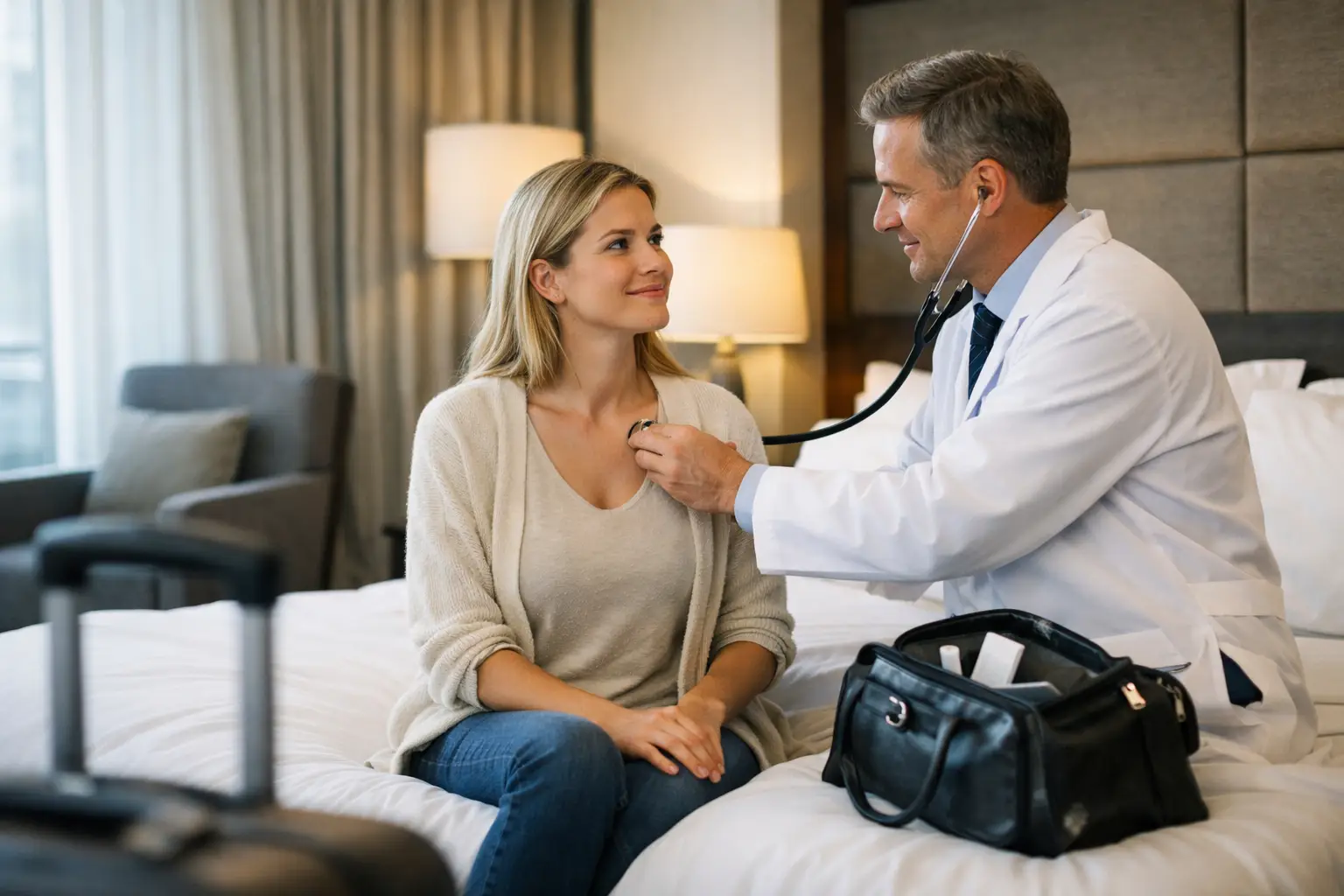
Anyone sitting in a hotel room with a fever, severe sore throat, circulation problems, or a suddenly ill child needs one thing above all: quick guidance. A medical house call at the hotel can be exactly the right solution when complaints are acute but there is no life-threatening emergency.
Especially on business trips or short vacations, what usually helps when you’re ill is often missing: the familiar family doctor’s practice, your own medicine cabinet, a relative who can drive. Added to this is the uncertainty of whether you need to go to an emergency room with the symptoms, should contact the on-call medical service, or whether a doctor can come directly to the hotel. For many hotel guests, the house call is the calmer and significantly more comfortable form of care.
When a Medical House Call at the Hotel Makes Sense
From a medical perspective, a hotel is not a special case, but organizationally it is a very unique place. You’re not at home, don’t know the area well, and often want to avoid neither long journeys nor a waiting room in a weakened state. This is exactly where a mobile private medical service shows its strength.
A medical house call at the hotel makes sense primarily for acute, non-life-threatening complaints. These include, for example, feverish infections, gastrointestinal complaints, acute pain, bladder infections, states of exhaustion, skin reactions, or dizziness. Even when a child suddenly falls ill at the hotel, an examination on-site is often the less stressful solution.
This model is particularly helpful for business travelers with tight schedules, for international guests, for people with limited mobility, and for anyone who values discretion. No one has to travel through the city while sick, search for a practice in an unfamiliar environment, or sit in a queue with obvious exhaustion.
What Can Be Treated On-Site at the Hotel
Many people underestimate how much medical care can be provided during a house call directly in the hotel room. It’s not just about a quick assessment, but often about a complete medical examination with concrete treatment.
Depending on the symptoms, a doctor can perform a medical history and physical examination on-site, prescribe medications, issue a sick note, treat wounds, or administer infusions. Assessing whether further treatment in a hospital is necessary or whether care at the hotel remains sufficiently safe is also part of this.
Typical situations include flu-like infections with a severe feeling of illness, severe throat infections, feverish infections in children, nausea and diarrhea with fluid deficiency, back pain after a long journey, migraine, or general weakness. Especially with exhaustion or dehydration, a medical assessment on-site can avoid a lot of unnecessary strain.
Of course, there are limits. A house call does not replace emergency medicine in cases of suspected heart attack, stroke, severe shortness of breath, impaired consciousness, or severe bleeding. In such cases, the emergency services via 112 are immediately the right choice. This distinction is important because quick help is only truly effective when it matches the medical need.
How the House Call at the Hotel Works
For patients, the biggest advantage is often not just the treatment itself, but the calm in the process. After initial contact, complaints, location, and urgency are assessed. Based on this, it is determined whether a house call is medically sensible and how quickly it can take place.
At the hotel itself, care is usually provided discreetly. It’s usually sufficient for the guest to inform the reception or leave the room number. The examination then takes place in the protected setting of the hotel room. For many, this is more pleasant than transport to a practice or clinic, especially with fever, pain, or nausea.
It’s important that patients have available information ready, as far as possible. This includes medications taken, known allergies, pre-existing conditions, and if necessary, identification documents or insurance information. If none of this is readily available, it’s not a reason for exclusion in an acute situation, but every piece of information helps with safe assessment.
Especially in hotels with an international clientele, clear communication is also crucial. Symptoms often develop at night or on weekends, when regular practices are closed. A well-organized mobile service takes pressure off the situation because it brings medical assessment and treatment directly to the location without detours.
Hotel Doctor, On-Call Service, or Emergency Room?
Many search for a hotel doctor and actually mean a medical house call at the hotel. The difference is less medical than organizational. A traditional hotel doctor is rarely a permanent solution belonging to the hotel today. In practice, it’s usually an external doctor or mobile service that comes to the hotel on request.
The on-call medical service is fundamentally an important point of contact outside regular consultation hours. However, it is not designed for a private medical visit model with short response time, individual care, and premium service. Those who primarily want fast, personal, and discreet help directly in the hotel room often consciously choose a private medical house call.
The emergency room is appropriate when complaints are potentially dangerous or immediate hospital infrastructure is needed. For many acute but non-life-threatening illnesses, however, it is not the most pleasant solution. Long journeys, waiting times, and the burden of transport are a real disadvantage, especially for weakened hotel guests.
It therefore depends on the individual case. Not every cold requires a doctor’s visit, but not every significant deterioration should wait until the next business day either. Exactly between waiting and the emergency room is often the sensible area of application for a mobile house call.
Discretion Is More Than a Comfort Issue at the Hotel
Anyone who needs medical help at a hotel often finds it uncomfortable. This applies equally to the sick business traveler before an important meeting, to parents with a feverish child, or to guests who simply don’t want their health condition to be publicly visible.
Discretion in this context means more than a quiet appearance. It begins with structured telephone assessment, continues with calm care on-site, and is also evident in personal communication. Good medicine during a house call is not hectic. It explains, assesses, and creates security.
Especially at the hotel, this human component is crucial. The room is temporarily the private retreat. When medical care takes place there, patients rightly expect respect, clear communication, and a professional process.
For Hotels, Medical Service Is a Quality Feature
From the hotel’s perspective as well, a reliable medical contact is relevant. Reception staff are often the first to be confronted with an ill guest. They can provide support but cannot make medical decisions. All the more valuable is a solution that quickly enables guests to receive genuine medical care.
For business hotels, serviced apartments, and high-quality hosts, organized access to medical help is often part of the service promise. This is especially true for late arrivals, international guests, or events with tight schedules. A medical house call at the hotel can avoid a lot of disruption and professionally defuse the situation.
In the Nuremberg, Fürth, and Erlangen metropolitan region, hotels are therefore increasingly using mobile private medical services when their guests need help outside usual practice hours. For the guest, what matters in this moment is less the structure in the background than the question of whether someone comes quickly, treats competently, and clearly explains what happens next.
What Patients Should Know Before Making a Decision
A medical house call at the hotel is a comfortable solution, but not a blanket one for every complaint. It is particularly suitable when a timely examination is necessary, but the condition remains stable enough for on-site care. If you’re unsure, describe the symptoms honestly. A serious assessment always begins with the question of what level of care is really needed.
Transparent billing is also important. Private medical house calls are usually billed according to GOÄ and are primarily aimed at private insurance holders and self-payers. This is not a detail, but part of the service model. In return, patients usually receive exactly the added value they seek in the situation: direct accessibility, medical time, personal care, and treatment without detours.
If you fall acutely ill at a hotel, you don’t automatically have to choose between toughing it out and the hospital. Sometimes the best decision is the one that brings together medical quality and peace of mind. That’s exactly when a mobile house call shows what good care means—where you are right now.


Leave a Reply