
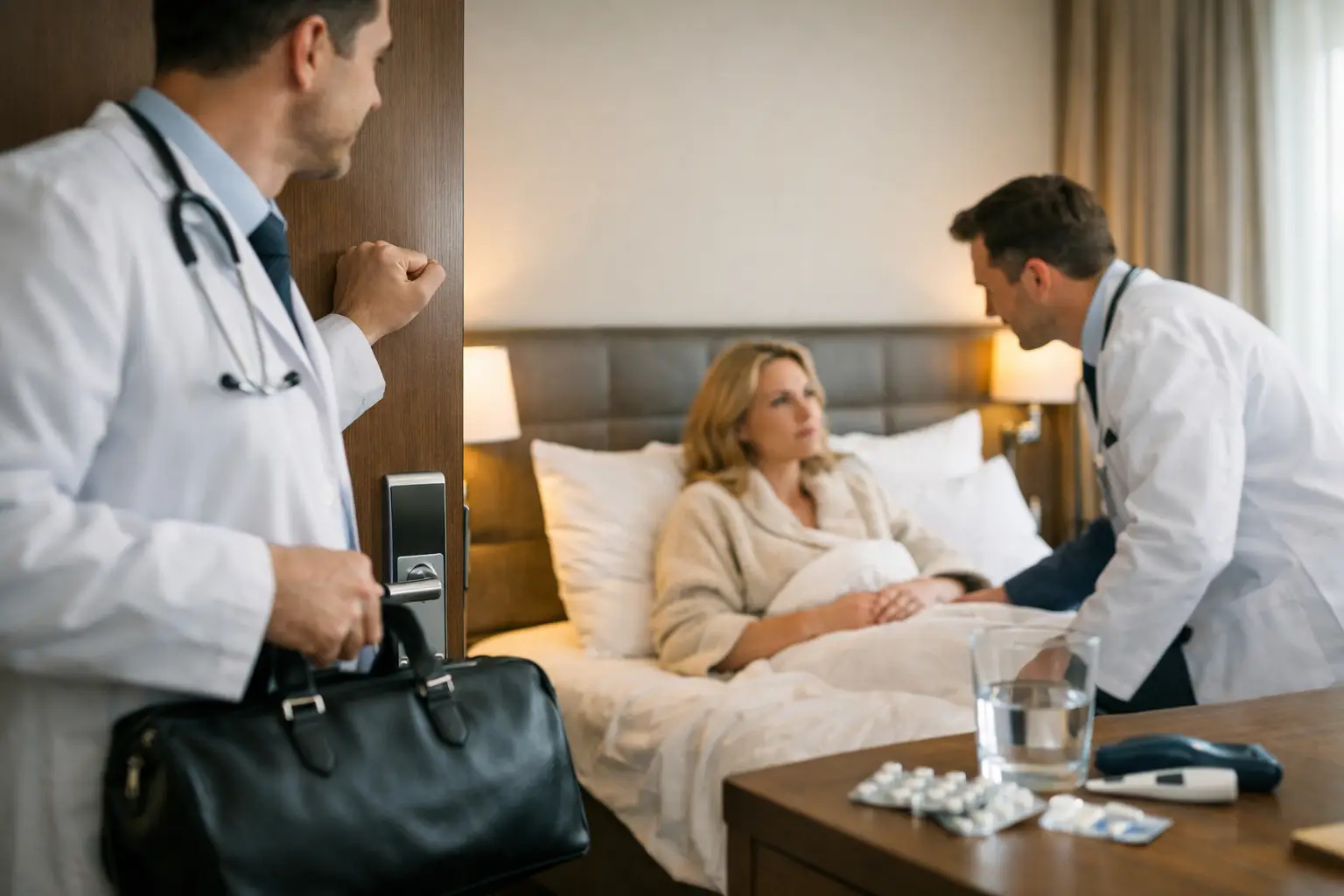
If you’re lying in a hotel room at night with a fever, suddenly develop a severe sore throat after a business trip, or are traveling far from home with a sick child, you don’t want a complicated solution. Being able to call a doctor to your hotel is often the most obvious and pleasant form of care in such moments—provided the symptoms are acute but not an emergency.
Especially when traveling, people often lack their usual sense of orientation. Which practice is open? How do you get there without a car? Do you speak the language well enough to explain symptoms? And is a waiting room really the best option when dealing with chills, nausea, or an exhausted child? A medical house call to the hotel takes exactly this pressure out of the situation. Treatment takes place where you already are—discreetly, personally, and without additional organizational effort.
When does it make sense to call a doctor to your hotel?
A hotel visit by a doctor is particularly useful when symptoms should be clarified or treated promptly, but the condition does not require an emergency response chain. Typical reasons include infections with fever, severe cold symptoms, gastrointestinal complaints, urinary tract infections, skin reactions, pain, circulatory problems, or minor injuries.
For travelers with limited mobility, the trip to a doctor’s office is also often unnecessarily burdensome. This also applies to people who value discretion or cannot afford a hours-long interruption between appointments, trade fair visits, or family plans. In a hotel, the time factor also plays a special role. Those who are only on-site for a short time usually don’t want to struggle to understand local healthcare structures.
A house call is particularly helpful when several factors coincide: acute symptoms, an unfamiliar environment, and the desire for quick clarity. In these cases, comfort is not a luxury, but part of sensible medical care.
What is possible during a medical visit to a hotel
Many people only think of a brief assessment when it comes to a medical visit to a hotel. In practice, much more is often possible. Depending on the symptoms, examination, consultation, and specific treatment can take place directly on-site. This includes physical examinations, issuing prescriptions, sick notes, wound care, or treating children.
Infusions can also be useful in appropriate cases, for example, for exhaustion, dehydration, or certain acute symptoms. At the same time, not every treatment belongs in a hotel room. If further diagnostics, imaging, or inpatient monitoring are necessary, a referral must be made accordingly. Good mobile medicine is also characterized by clearly stating the limits of a house call.
This exact assessment is valuable for patients while traveling. It’s not just about someone coming; it’s about someone making a sound medical decision on what is possible on-site and what is not.
What is the process when you call a doctor to your hotel?
The process is usually simpler than many expect. First, the symptoms are briefly described over the phone or during the inquiry. This involves assessing the urgency, the location, and whether a house call is medically appropriate. Information about symptoms, pre-existing conditions, allergies, medications, and the room number or reception is important.
The doctor then comes directly to the hotel. On-site, the examination takes place in a quiet environment, without a waiting room and without the additional stress of travel. Especially with fever, pain, or weakness, many patients find this to be a noticeable relief.
After the examination, the findings are discussed, along with which treatment makes sense and what happens next. Depending on the situation, there may be medication, recommendations for further observation, a prescription, or a clear recommendation to visit a hospital. Transparency is crucial here—both medically and regarding billing.
This process is also helpful for the hotels themselves. The reception doesn’t have to improvise but can help guests in a stressful situation in an organized manner. This creates security for both sides.
Call a doctor to the hotel or rather 116117?
This is a valid question, and the answer depends on the situation. 116117 is the right choice if you need medical help outside of regular office hours and are not sure where to turn. They provide a medical assessment of whether an on-call service, an after-hours clinic, or another form of care is appropriate.
A private medical hotel visit, on the other hand, is primarily interesting for people who want direct, comfortable, and personal care on-site—without long waiting times, without travel, and with more time for consultation. This is particularly attractive for business travelers, hotel guests with tight schedules, families with children, or people with high service expectations.
Both have their place. The difference lies not only in accessibility but also in the approach to care. Those primarily looking for quick standard guidance are in the right place with 116117. Those specifically wanting a doctor’s visit to the hotel with discreet, individual care are more likely to choose a mobile private medical service.
When you should not simply call a doctor to your hotel
As practical as a hotel visit is—it is not the right solution for real emergencies. In cases of chest pain, acute shortness of breath, signs of paralysis, severe neurological deficits, seizures, impaired consciousness, or serious accidents, every minute counts. In these cases, 112 must be called immediately.
Also, in cases of high fall risk, heavy bleeding, or suspected heart attack or stroke, it’s not about comfort, but about rapid emergency care. Distinguishing this clearly is important. A good mobile medical service will therefore always first check whether a house call is even an option.
Uncertainty is normal in these situations. Especially when away from home, people tend to either dramatize or downplay symptoms. If you feel that a condition could be threatening, the emergency call is the right priority.
Who benefits most from a medical hotel visit?
Business travelers benefit particularly strongly. Those who are only on-site for one or two days cannot simply wait out an infection or severe symptoms and often have neither the time nor the energy to search for a suitable practice. The doctor comes to where the patient already is.
For families, the advantage is even more obvious. Caring for a sick child in a hotel room while being in an unfamiliar city can quickly become overwhelming. An examination in the familiar environment of the room is usually calmer for children than a crowded waiting area.
Tourists also appreciate the discretion and the clear process. No one wants to spend hours deciphering local healthcare during their vacation. Those with private insurance or those who consciously opt for fast medical help as self-payers often choose a house call for exactly this reason.
In the Nuremberg, Fürth, and Erlangen area, this model is particularly useful when symptoms occur outside regular practice hours and personal care on-site is desired. nightdoc.de is specifically designed for such assignments—in hotels, apartments, or other locations.
What you should have ready when the doctor arrives
The better the information, the more targeted the care. Helpful items include an ID, insurance or billing details, a list of medications being taken, and—if available—relevant previous findings. In a hotel, it is also sensible to briefly inform the reception so that access goes smoothly.
If children are affected, parents should be able to describe as accurately as possible how long the symptoms have existed, whether a fever was measured, and how the child is drinking or reacting. For adults, information on the onset of pain, pre-existing conditions, and allergies is often particularly important. These details save time and improve the medical assessment.
It’s not about perfection. No one needs to have everything organized while they are sick. But a few pieces of clear information help so that the treatment can focus directly on the essentials.
Anyone who needs medical help in a hotel is usually not looking for a grand solution, but a reliable one. That is exactly why the house call is so convincing in many situations: it brings medical clarity to where uncertainty is currently greatest.


Leave a Reply