
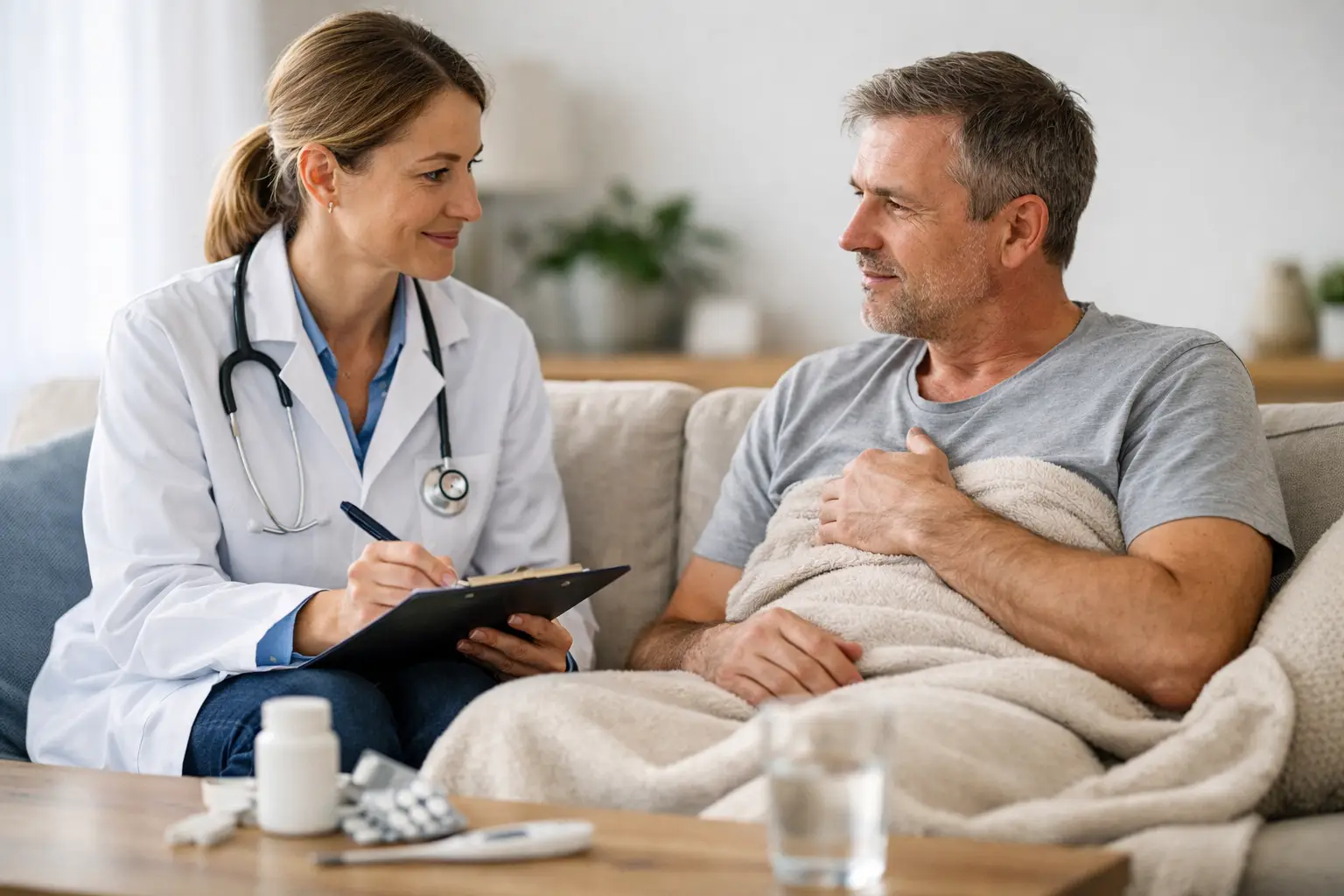
Fever in the evening, severe sore throat at night, or a child weakened by infection on the sofa—at times like these, the question arises not only about treatment but also about a certificate of incapacity for work. A sick note during a home visit is generally possible if a doctor determines, after a personal examination, that incapacity for work exists. What matters is not the location of the examination, but the medical assessment.
When Is a Sick Note During a Home Visit Possible?
Many patients assume that a sick note can only be issued at a practice. That’s not correct. If the examination is conducted during a medical home visit, a certificate of incapacity for work can be issued just the same—provided the complaints justify it from a medical perspective.
Typical situations include acute infections with fever, gastrointestinal complaints, severe pain, pronounced exhaustion, or other acute, non-life-threatening illnesses where the trip to a practice would be unnecessarily burdensome. Especially when someone can barely get out of bed, has circulatory problems, or should not infect others, a home visit is not only convenient but often sensible.
An important distinction: A sick note is not a mere formality issued on request. Doctors must assess whether the health impairment actually prevents the current professional activity from being performed temporarily. Someone working in an office will be evaluated differently than someone with physically demanding work.
How Does a Sick Note During a Home Visit Work?
The process is usually straightforward. First, the complaints are described, then the medical examination takes place on-site. Depending on the situation, temperature, circulation, airways, abdomen, throat, or other affected areas are examined. Pre-existing conditions, medications, and the course so far also play a role.
If it is determined that incapacity for work exists, the certificate can be issued directly. In many cases, patients receive the documents immediately at the appointment or afterward in the agreed form. How long the sick note is valid depends on the findings. For an uncomplicated infection, a few days are often sufficient; for more severe complaints or a slow course, a reassessment may be advisable.
One thing is especially important for patients: Even during a home visit, a genuine medical assessment is required. Anyone who only wants a certificate without being examined is not receiving proper medical care. Good care always means examination first, then decision.
What Doctors Assess
Whether someone is incapable of work is not determined by the diagnosis alone. It’s about whether the specific activity is currently reasonable. A mild cold may be assessed differently for someone working from home than for someone doing shift work, field service, or physically strenuous jobs.
Infection control also plays a role. Anyone with high fever, severe cough, gastrointestinal symptoms, or a clear infection is not only personally impaired but should often stay home out of consideration for colleagues or customers. For other complaints, such as back pain or migraines, functional impairment is more the focus.
Doctors therefore always weigh each case individually. This is also an advantage of the home visit: The examination takes place without rush in familiar surroundings, and there is usually more room for the actual situation than in a crowded waiting room under time pressure.
For Whom Is a Home Visit Particularly Useful?
A sick note during a home visit is especially helpful when the trip to a practice itself becomes a burden. This applies to people with acute infections, limited mobility, pain, dizziness, or severe weakness. Parents also know the situation: The child is sick, you yourself are also feeling unwell, and the trip to the nearest open practice quickly becomes an organizational ordeal.
The home visit is also relevant for business travelers, hotel guests, or visitors who are unfamiliar with the area and need medical help at their location on short notice. In such cases, not only medical care matters, but also clear, calm organization without unnecessary trips.
Especially outside regular practice hours, a home visit can be a suitable solution when complaints are acute but not an emergency requiring emergency services. For life-threatening symptoms such as chest pain, shortness of breath, paralysis, loss of consciousness, or serious accidents, however, the rule is always: call 112 immediately.
What Employees Should Know
Anyone who is sick must usually inform their employer without delay. The medical certificate is to be considered separately. When it must be submitted depends on the employment contract, company regulations, or the specific requirement of the employer. Some require it from the first day, others later.
What matters medically: The certificate of incapacity for work confirms that an activity is temporarily not possible for health reasons. It does not replace communication with the employer. Therefore, it makes sense to report early and not only when the documents are available.
If the complaints persist, a renewed medical assessment should take place in good time before the existing sick note expires. Retroactive certificates are only possible within narrow limits and should not be relied upon. Anyone who notices that their condition is not improving should arrange for a follow-up evaluation early.
Children Sick, Parents Stressed
Particularly relevant in everyday life is the question of sick children. If a child becomes acutely ill and needs to be examined, a home visit can be a significant relief for families. This is especially true for fever, infections, vomiting, or situations where a waiting room would be additionally stressful for the child.
For parents, it’s important to distinguish between a sick note for their own illness and medical certificates related to the sick child. Which documents are needed for employers or health insurance depends on the specific case. A clear medical assessment on-site helps avoid misunderstandings.
Especially with small children, the value of a calm examination at home should not be underestimated. The child stays in familiar surroundings, parents save trips, and medical decisions can often be made more clearly when the journey itself hasn’t already exhausted everyone involved.
Private Medical Home Visit: What’s Different?
A private mobile home visit service is aimed at people who want quick medical help without a waiting room and without travel. This is particularly attractive when complaints occur in the evening, at night, or on weekends and a personal examination is needed. In the Nuremberg, Fürth, and Erlangen area, this model is offered by nightdoc.de, among others.
The difference from regular structures lies less in the medicine than in access and service. Patients receive medical care at their location, often with more time for examination, explanation, and practical questions. Certificates of incapacity for work can also be issued if the findings justify it.
An honest distinction is important: A private medical home visit replaces neither emergency services in emergencies nor every specialist follow-up treatment. It is a sensible option for acute but not life-threatening complaints when quick personal care on-site is needed.
Common Misconceptions About Sick Notes During Home Visits
A widespread misconception is that it’s easier to get a sick note during a home visit. Viewed seriously, the opposite is more accurate: The same medical standards apply at home as in the practice. The findings decide, not convenience.
The duration is also often misunderstood. Not every illness automatically justifies several days of incapacity for work. Sometimes a short period is sufficient, sometimes close monitoring is better. Especially with unclear courses, much depends on the development in the next 24 to 48 hours.
And one more point: Anyone who appears seriously ill but actually has an emergency needs not a sick note but immediate acute care. A good medical assessment recognizes this boundary and acts accordingly.
Anyone who feels sick and can’t make it to the practice right now doesn’t have to lose medical care between the sofa and the waiting room. A thorough examination at home can not only clarify complaints but also provide the necessary guidance for work, family, and next steps.


Leave a Reply