

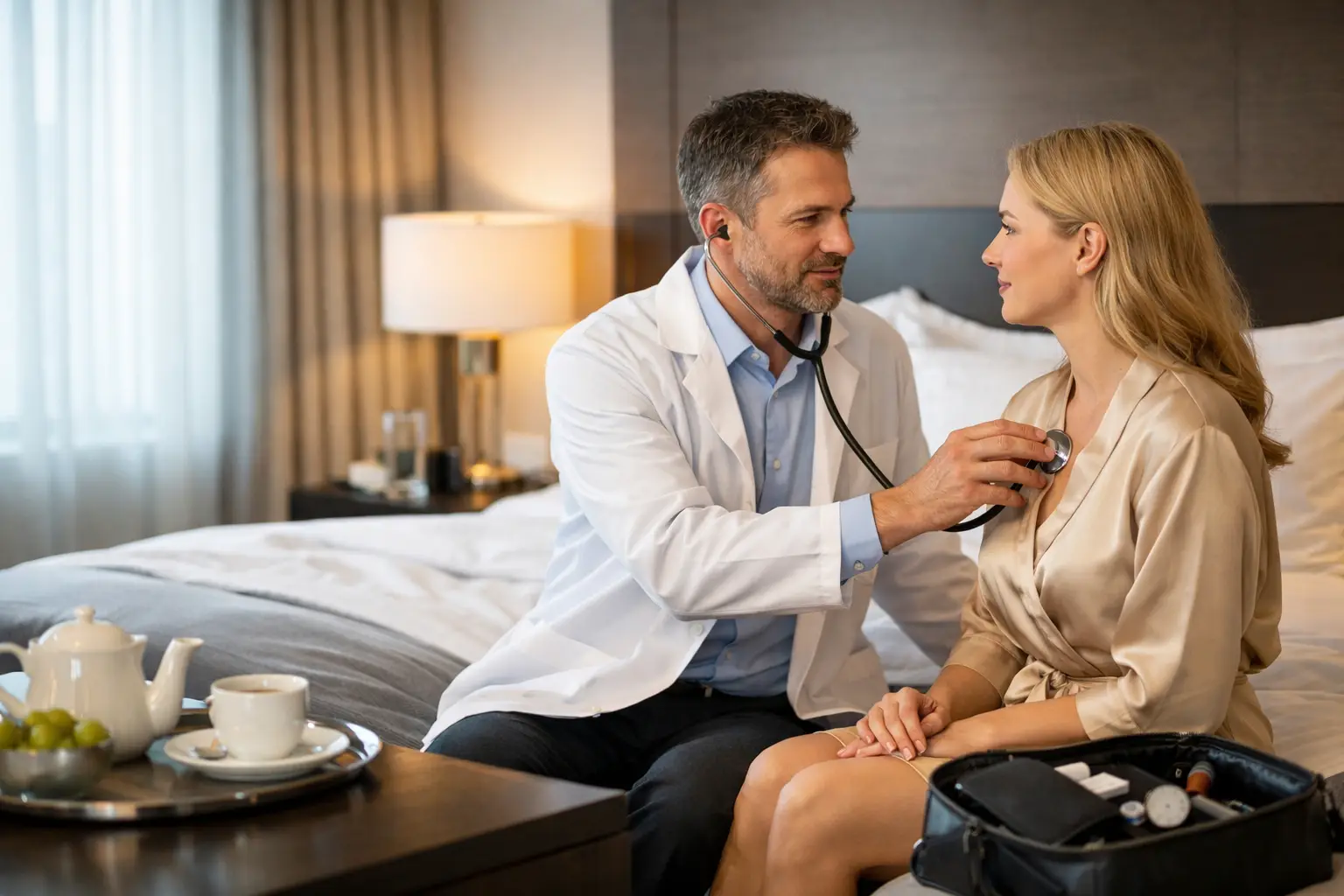
Fever in the evening, severe sore throat before a trade fair appointment, or a sick child in the hotel room – in moments like these, the question isn’t whether you need medical help, but how to arrange it quickly and discreetly. Calling a doctor to your hotel is the most comfortable solution for many guests when complaints are acute but not life-threatening.
Calling a Doctor to Your Hotel – When Does It Make Sense?
A hotel stay often makes health problems more complicated than they already are. You don’t know the area, don’t know which practices are still open, and getting to an emergency room with fever, vomiting, or circulation problems can be very stressful. On top of that: whether traveling for business or with family, most people want to resolve the situation quickly, calmly, and without a lot of organizing.
This is exactly where a medical house call at your hotel can make sense. Typical reasons include infections, gastrointestinal complaints, pain, fever, urinary tract infections, skin reactions, circulation problems, or the question of whether a trip should be continued. For children especially, treatment in the familiar room is often much more relaxed than in a crowded urgent care practice.
The distinction is important: a mobile doctor service at your hotel is intended for acute but not life-threatening complaints. For chest pain, shortness of breath, stroke symptoms, severe injuries, impaired consciousness, or other emergencies, the emergency services via 112 are the right choice.
What Hotel Guests Really Need in This Situation
When you’re sick in a hotel room, you’re usually not looking for lengthy medical theory, but three things: quick orientation, a clear decision, and reliable help on-site. This applies equally to tourists and business travelers who have an important appointment the next morning.
A doctor’s visit at your hotel doesn’t just save the journey. It also reduces stress. You stay in your environment, don’t have to organize a taxi, don’t have to sit in a waiting room, and don’t have to describe complaints in passing. Especially when discretion is important, such as on business trips, this is a real advantage.
There’s also medical added value. During an on-site visit, it’s often easier to assess how severely someone is actually affected. Doctors can examine, advise, treat, and also clarify whether further diagnostics, a prescription, a sick note, or a hospital visit makes sense.
How It Works When You Call a Doctor to Your Hotel
The process is usually straightforward, but should be professionally managed. First, you describe the complaints by phone or in your inquiry as precisely as possible. Particularly relevant are symptoms, onset, pre-existing conditions, the patient’s age, and the exact hotel address including room number or accessibility via reception.
Next, an assessment is made as to whether a house call is medically appropriate or whether another form of care would be more suitable. This assessment is important because not every problem should be treated at the hotel. Good providers clearly state when an emergency exists or when a clinic would be more appropriate.
If the visit takes place, the examination is conducted directly in the hotel room. Depending on the complaint, treatment can include various services: physical examination, wound care, prescription of medications, issuing a prescription, infusions, symptomatic acute therapy, or a certificate of incapacity for work. For children, much is often gained simply by having the examination and consultation without an unfamiliar environment and without long waiting times.
Afterward, you receive a clear recommendation for the next hours and days. This includes an honest assessment of whether bed rest is sufficient, whether medication is necessary, or whether further diagnostics should be arranged. Good mobile private doctors don’t work according to the motto “comfort at any cost,” but according to medical appropriateness.
Which Complaints Can Often Be Treated at the Hotel
Not every illness requires immediate hospitalization. At the same time, you shouldn’t wait too long with complaints just because you’re traveling. Conditions that can often be treated well at the hotel include feverish infections, cold symptoms with significant malaise, gastrointestinal infections without severe dehydration, throat infections, earaches, urinary tract infections, allergic reactions without shortness of breath, back pain, migraines, or minor injuries.
Exhaustion, circulatory weakness, or dehydration after long travel days can also be a reason for a medical visit. This depends heavily on the individual case. Sometimes advice and oral therapy are sufficient, sometimes an infusion makes sense, and sometimes the examination reveals that further treatment is necessary after all.
Especially for elderly people, children, or persons with pre-existing conditions, the threshold for medical evaluation should be rather low. What looks like a harmless infection in a healthy adult can become relevant more quickly in others.
When 112 or 116117 Is the Better Choice
Anyone wanting to call a doctor to their hotel should know the limits of this service. This creates safety and prevents delays.
112 is correct for life-threatening or potentially life-threatening situations. These include severe shortness of breath, pressure or pain in the chest, sudden paralysis, seizures, severe bleeding, severe allergic reactions, unconsciousness, or suspected heart attack and stroke.
116117 is the right point of contact when you need medical help outside practice hours and don’t specifically want a private medical house call. There you’ll be referred to regular on-call care. This can be a good fit when time is less critical or when you consciously want to use the statutory health insurance structure.
A private mobile medical service is particularly appropriate when you want quick help on-site, are not transportable or have limited mobility, value discretion, or want to avoid long waiting times. In the Nuremberg, Erlangen, and Fürth metropolitan region, such a house call is often the most direct solution for hotel guests when the situation is acute but manageable.
What Does a Doctor’s Visit at the Hotel Cost?
This question is justified and should be answered transparently in advance. For a private medical house call, billing is usually according to GOÄ. The actual costs depend on which services are medically necessary, at what time the visit takes place, and whether additional measures such as infusions, bandages, or certificates are added.
For self-payers, it’s especially important that they’re given a realistic price range in advance. Private insurance holders should check to what extent their insurance covers general practitioner private services and house calls. What matters is not the cheapest price, but clear communication without surprises.
Especially in the hotel context, the value of transparency becomes clear. When you’re feeling sick, you don’t want to decipher complicated fee models first. Reputable providers therefore openly explain what will be billed and which factors influence the price.
What to Look for When Choosing a Service
Not every mobile service offers the same standard. When organizing medical help at your hotel, you should ensure that communication is calm and competent, a genuine medical initial assessment takes place, and the service’s limitations are clearly stated.
It’s also a good sign when not just the visit itself, but the entire situation is considered. This includes coordination with reception, discreet conduct, clear documentation, and willingness to refer to other care structures when needed. Premium in this context doesn’t mean luxury, but reliability under pressure.
nightdoc.de is designed specifically for such mobile private medical calls – with medical care on-site, personal attention, and clear distinction from emergency services and statutory on-call services.
What Hotels and Business Apartments Gain from This
For hotels themselves, an available doctor service is also a quality feature. Guests today expect not just a good room, but help when something goes wrong. When you’re sick, you remember less about breakfast than whether help was provided quickly, discreetly, and humanely.
For reception and guest relations, a reliable medical contact is therefore more than an additional service. It relieves the team, creates security in dealing with ill guests, and noticeably improves service quality. Especially with international guests, families, or long-term stays, this can make the difference.
When Quick Help Saves the Stay
Calling a doctor to your hotel isn’t the solution for every situation, but often the best one for exactly that moment when you’re sick, exhausted, and unable to navigate an unfamiliar healthcare system. What matters is a medically sound assessment, a clear process, and the good feeling of being taken seriously on-site. When that succeeds, a stressful situation becomes at least a manageable one.


Leave a Reply