

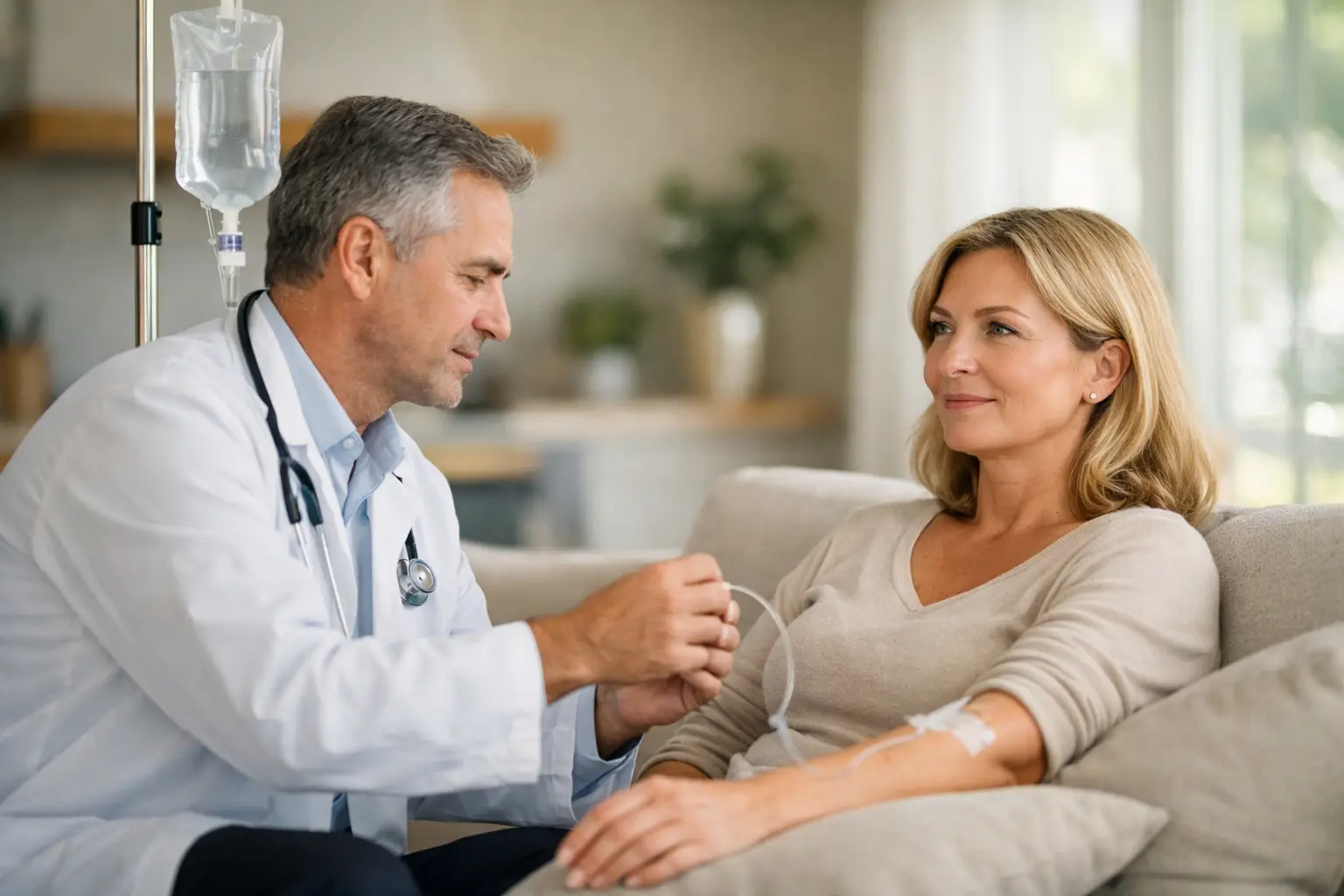
When you can barely stay on your feet due to nausea, circulatory weakness, or significant dehydration, the last thing you want is to sit in a waiting room. In precisely such moments, the question of an IV infusion at home by a doctor becomes very real: Is it medically sensible, safe, and even organizationally possible? The short answer is: yes, in appropriate cases. The longer answer is crucial—because not every bout of exhaustion requires an infusion, and not every situation belongs in home care.
When an IV Infusion at Home by a Doctor Can Make Sense
An infusion is not a wellness measure but a medical treatment with a clear indication. It is primarily considered when fluids, electrolytes, or medications need to be administered precisely and reliably via the vein. This is relevant, for example, in cases of severe dehydration following gastrointestinal infections, persistent vomiting, circulatory problems, feverish infections, or certain pain and weakness conditions.
The advantage of treatment at home is obvious: the patient remains in familiar surroundings, does not need to be transported, and can be cared for under medical supervision without the additional burden of travel, waiting times, or an overburdened healthcare system. Especially for elderly people, families with sick children, hotel guests, or people with limited mobility, this can make a real difference.
Nevertheless, one thing is clear: an infusion is never simply a convenient shortcut. Every administration is preceded by a medical assessment. The deciding factor is whether the symptoms can be safely treated at home or whether further diagnostics or inpatient care would be necessary.
What the Doctor Checks First On-Site
Before an infusion is even prepared, a medical examination is required. This is not just about whether someone feels “weak,” but why. A dry mouth, dizziness, weakness, and low blood pressure can indicate fluid deficiency. However, they can also have other causes—ranging from infections to cardiovascular problems to more serious internal medical conditions.
The doctor therefore takes a medical history, reviews comorbidities, medications, allergies, and the current condition. Vital signs such as pulse, blood pressure, oxygen saturation, and temperature are checked as appropriate. The overall impression also counts: Is the patient oriented? Can they drink? How long have the symptoms persisted? Are there warning signs such as chest pain, shortness of breath, neurological deficits, or severe abdominal pain?
Only when the overall picture fits is a decision made as to whether an infusion on-site is medically indicated and safely feasible. This step is precisely what distinguishes serious medical treatment from blanket promises. Not every case of exhaustion improves with fluids. And sometimes the right course of action is not an infusion in the living room, but immediate referral to a hospital.
Which Infusions Can Be Considered at Home
Which solution or medication is administered always depends on the findings. Often it involves fluid and electrolyte replacement, such as after diarrhea, vomiting, or significantly reduced fluid intake. In other cases, medications for nausea, pain, or cramping may be part of the treatment—naturally only following medical indication.
Even with feverish infections or conditions involving significant weakness, an infusion can help stabilize circulation and ease the situation in individual cases. However, this does not replace further diagnostics if the course is unclear or risk factors are present.
Home infusion therapy is less suitable where close monitoring would be necessary. Patients with severe heart or kidney disease, for example, require special caution because additional fluids can also strain the body. This is precisely why careful medical selection is so important.
How an IV Infusion at Home by a Doctor Typically Works
In practical terms, the treatment is far more structured than many expect. After arrival, an examination and assessment of the symptoms is conducted first. If the infusion is medically appropriate and there are no exclusion criteria, the vein is accessed, the infusion is prepared, and the administration is monitored.
During this time, the doctor typically remains on-site and observes how the patient responds. Checks are made to ensure circulation remains stable, whether nausea or dizziness improves, and whether there are signs of intolerance. A reassessment follows after the infusion is completed. Sometimes a single treatment is sufficient. Sometimes it becomes clear that additional measures are needed—such as medications, follow-up monitoring, or a recommendation for further evaluation.
For patients, it is often reassuring that the treatment does not take place in a rush. Especially in the home environment, there is usually more room for questions, clarification, and individual assessment than in heavily utilized acute care settings. This creates security without losing medical seriousness.
For Whom Treatment at Home Is Particularly Helpful
Not everyone needs a house call, but for some people it is the most sensible solution. This applies, for example, to individuals who are barely transportable due to acute symptoms but do not have a life-threatening emergency. Parents also know how stressful it can be to take a sick child across town at night or on the weekend when the situation is urgent but not an emergency.
Business travelers and hotel guests also frequently benefit from on-site treatment. Someone who is unfamiliar with the city, lying weakened in a hotel room, and unable to assess whether an emergency room is necessary needs one thing above all: quick, clear medical guidance. The same applies to people who prefer to be treated in their own environment for reasons of discretion.
In the Nuremberg, Fürth, and Erlangen area, a mobile private medical house call service like nightdoc.de can fill precisely this gap—between an unnecessary trip to the hospital and waiting despite significant symptoms.
Where the Limits Are
As convenient as an IV infusion at home by a doctor can be, it has clear limits. In cases of chest pain, shortness of breath, paralysis, seizures, loss of consciousness, severe bleeding, or suspected stroke or heart attack, it is not the right approach. In such cases, immediate emergency care via 112 is essential.
Even with severe dehydration, unclear deterioration of general condition, or suspected complicated courses, hospital care may be necessary. The distinction is important: mobile home medical care is intended for acute but not life-threatening symptoms. It replaces neither emergency services nor inpatient monitoring.
Anyone who is uncertain should not first think about the most convenient option, but about the medically correct care. A good mobile medical service will address this openly and clearly state when the situation no longer belongs in the home setting.
Common Misconceptions About Infusions at Home
A widespread misconception is that an infusion always works faster than drinking fluids and resting. This is only partially true. If someone is actually dehydrated, vomiting severely, or reliably needs medications intravenously, the infusion can be very useful. In cases of mild exhaustion without relevant fluid deficiency, the benefit is often limited.
Equally false is the assumption that an infusion is automatically harmless. Here too there are risks, such as during venous access placement, with intolerances, or when comorbidities are not sufficiently considered. This is precisely why the decision belongs in medical hands.
And one more thing: not every home infusion is the same. The difference lies in the on-site medical assessment, monitoring, and the experience of the treating physician. Those seeking quality should not look for buzzwords, but for reliable medical care.
What Patients Should Know in Advance
When a doctor comes to the home for an infusion, it helps to have certain information ready. Relevant details include current medications, known allergies, pre-existing conditions, and the timeline of symptoms. The question of how much has been drunk in recent hours, whether vomiting or diarrhea is present, and whether fever has been measured is also often important.
Practically speaking, a quiet sitting or lying area with some space is usually sufficient. In many cases, nothing more is needed. What matters less is the environment than an honest description of the symptoms. The clearer the picture, the better the care can be assessed.
With private medical house call services, cost transparency is also part of the package. Billing is typically based on the GOÄ fee schedule. For privately insured patients, reimbursement depends on the individual plan; self-payers receive a clear, itemized invoice. Especially in acute situations, clear communication about this is reassuring.
Anyone considering an infusion at home is usually not looking for a special solution, but for a sensible medical response to a stressful situation. That is exactly what it is about: treatment that is professionally appropriate, organizationally relieving, and does not lose sight of the person. When medical diligence, time, and a clear view of the limits come together, care in one’s own environment can be not only comfortable, but simply the better decision.


Leave a Reply